
Guest Post by Ivan
*The following article has been written by Ivan and strictly reflects his personal opinion. This article should not be interpreted as an attack against any religious organization or individual.
The existence of a God has often been widely debated. As a nonbeliever of any supreme being or creator God, I will attempt to bring the scientific evidence against the possibility of a God or transcendental form of consciousness beyond the limits of neurological processes.
Philosophy
Before I begin discussing about the various evidences for the nonexistence of God, I will first discuss about the fundamental philosophy regarding the debate. First of all, the existence or nonexistence of a God cannot be proven. If a God does not exist, then obviously its nonexistence can never be proven. As an analogy, if I say that there is a Chinese teapot orbiting the sun between Earth and Mars (Russel's teapot), can anyone disprove me? Of course not. Likewise, no one can prove if it exists. Of course, we know that it does not exist because nothing proves its existence. On the other hand, if a God exists, we can never prove it unless the God decides to show itself to the world. Despite this impossibility of proving or disproving God, it is still possible to provide evidence for and against each side to add to the argument. Like the Chinese teapot analogy, an absence of empirical observation would mean that its nonexistence would be accepted unless proved otherwise.
However, the important thing to note at this juncture is that the debate revolves around evidence that shows how probable or improbable God’s existence is. It is in this post that I will give evidence for the latter in the form of scientific evidence and logical reasoning.
Part 1: The Origin of the Universe
One of the most important arguments put up by theists is the concept of the first mover, or primum movens. The idea is based on the axiom of causality which would logically indicate that a set of causes for the universe’s existence would extend to infinity, which is impossible. In order to solve the problem, theists would invoke the idea of a God. This idea is augmented by the law of conservation of energy, which states that energy in a closed system can never be created nor destroyed.
However, an important philosophical argument would render this concept false. Since the laws of physics, as well as the axiom of causality, is created at the time of the big bang, it is perfectly possible for energy to be created out of nothing and spontaneous creation to take place without the need for physical laws to be fulfilled. It is the nonexistence of causality and physical laws before the big bang that permits spontaneous creation to occur. Presently, it is thought that a hyperspace exists to allow such spontaneous creation of an infinite number of galaxies. I will discuss this on more detail later on.
Part 2: The complexity of the Universe
For most people, space is simply the black sky that hovers over their heads every night. In the past century, however, the magnificence of our universe has started to reveal itself to science. To put things into perspective, the observable universe is calculated to be 93 billion light years across (one light year is equivalent to 9.46 trillion kilometres), with the Earth being at the centre (since the calculation of the horizon is based on Earth’s perspective). In the observable universe, there are approximately 8 quintillion stars, with the sun being just one of many. I derived this number from the calculation of the number of galaxies observed by the Hubble ultra deep field, multiplying that value to the area of the night sky, and multiplying that number to the number of stars in one galaxy. This is a staggering number indeed, and it shows that Earth, being only a tiny speck of dust in the great cosmic depths, is not as special as it was once thought to be.
The universe has a beautiful set of physical laws in terms of mathematical aesthetics. Equations are always symmetrical in terms of the values on both sides, the golden ratio is found naturally in organic life, and the precise arbitrary constants of the standard model allow the existence of stable matter for life to exist. I have realised that many theists enjoy using the complexity of the universe as evidence for intelligent design. Of course, all becomes clear when the anthropic principle is understood.
First of all, the laws of the universe are undoubtedly perfect for life to form. Should the mass of the proton change by a tiny fraction, stable matter would not exist. The Earth has a perfect atmosphere and temperature for life to evolve, and the laws of physics and chemistry drives evolution in a positive direction. However, this apparent coincidence is actually based on a sort of observation-selection bias. If the conditions of the universe (and Earth) were not perfect, there is absolutely no way that life could exist. If life did not exist, we wouldn’t even be here to ponder about our existence. In today, modern physics has begun to unravel a world that is much stranger than we thought. Most scientists now believe that there is more than just the three dimensions we know today. In total, eleven dimensions are thought to exist, with only the limits of sensory perception limited to the familiar three causing the illusion that higher dimensions do not exist. With this, it is also thought that an infinite number of parallel universes exist alongside ours; each with a different set of physical laws that determine how the universe works. Using the anthropic principle, we would then realise that only habitable universes can contain life. Since life is indeed formed upon rare chance, we would assume most universes to be devoid of life, or even stars. Likewise, it is only through habitable conditions of Earth that life could exist here.
Another argument related to the anthropic principle on a planetary scale is the low probability of abiogenesis. According to creationist statistics, the probability of a protein molecule forming by itself is less than that of a hurricane sweeping through a metal scrap yard and assembling a working Boeing 747 (Hoyle’s fallacy). However, when we look at the staggering number of stars in the universe, it is obvious that this probability is overcome easily. Furthermore, the 15 billion-year old universe would have provided sufficient time for this to occur. Most importantly, however, the autosynthesis of liposomes and microspheres (membrane-bound RNA, believed to the earliest form of life on Earth) has been performed in the laboratory. This shows that the probability calculated by the creationists is not accurate in the first place.
Another argument that is often put up by theists is the apparent beauty of nature. To them, the grandeur of the sunset and breathtaking views of Earth from atop a mountain is due to the work of intelligent design. However, what they fail to take into account is the fact that our brains are adapted to the Earth and universe that we inhabit after four billion years of constant evolution. As an analogy, us humans would often feel repulsed at the sight of a female cockroach. To a male cockroach, however, the structure of a female cockroach is perfectly and beautifully designed. This was a requirement for reproduction and their survival as a species. The most important thing about this analogy, however, is that it shows how beauty is only the result of adapted psychology. This means that the mathematical and aesthetic beauty of the universe is the byproduct of evolution and not a creator. This brings me to my next point on evolution.
Part 3: Evolution
The theory of evolution is often one of the most widely-debated topics as it directly challenges the claims made by the Christian genesis. Although evolution is described as a ‘theory’, it has as much doubt in biology as quantum physics had in physics. This is important to note as many creationists argue that evolution is ‘only a theory’. By their definition, atomic theory and the theory of relativity would be only theories. As an analogy of scientific theories and facts, the constant rising of the sun in the East everyday is now established as a fact since all observational evidence proves it. If, however, the sun rises in the West one day, the theory would be proved wrong. The same goes for evolution: to date, all scientific data supports it. However, it is very susceptible to being disproven because a single evidence against it would render it untrue. In fact, the theory is supported by a massive amount of evidence which I will now put forward. At the same time, I will also clarify some of the misconceptions about evolution based on the people who argue against it.
First of all, what exactly is evolution? Evolution is actually the process whereby small changes in the form of genetic mutation occur along every generation that produces a substantial shift in genetic composition of an organism from its distant ancestors and is naturally selected due to its chances of survival. Evolution is a gradual process that occurs in every generation. While the genetic composition of the offspring is almost genetically identical to that of the parents, small changes in genes over hundreds or thousands of generations would eventually cause a significant change in the observed characteristics that differentiate the descendent species from the ancestral species. Traits that are beneficial for an organism’s survival is selected preferentially due to the fact that organisms with beneficial traits would survive better and hence be able to reproduce. Over time, constant sexual reproduction would cause beneficial genes to be spread across the entire population of a species, causing a shift in the genetic composition.
It is important to note that all organisms are transitional species between two others. Due to the fact that evolution is a gradual process, transitional fossils exist to show the smooth transition of one species to the next. In the case of humans, the chimpanzee-like australopithecines evolved to species with the genus homo, such as Homo erectus and homo habilis right up to homo sapiens as shown by fossil evidence. Although many creationists maintain that evolution is false because humans evolved from monkeys, it is important to note that modern species do not evolve from modern species. Rather, humans and monkeys share a common ape-like ancestor. In fact, all organisms share a common ancestor with one another. The only difference is, the greater the difference in genetic composition, the more distant that common ancestor is.
Another important evidence for evolution, besides the transitional fossils, is the experimental observations of evolution occurring in the laboratory. Known as the Escherichia Coli Long term evolution experiment, twelve containers of the bacteria are allowed to grow in a nutrient broth of glucose and citric acid. Due to the rapid rate of reproduction, a small sample of the bacteria would be extracted from each container daily and allowed to reproduce to the original amount on the next day. The rest of the bacteria would be frozen for observational analysis. The experiment has been going on for over twenty years, and has recently reached the 50,000th generation early this year. The significance of this experiment is that the results showed ongoing evolution in all of the different containers. The bacteria in each different container would take a different evolutionary path due to random mutations. The results were indeed stunning. At first, the original bacteria sample could only thrive on glucose as the source of food. However, one sample suddenly managed to evolve and utilise the citric acid mixed with the glucose in the nutrient broth, resulting in a sudden surge in bacteria count for that particular flask. This shows that ongoing evolution can and has been observed, and the fact that it is done based on empirical methods would mean that evolution can be directly verified.
Intelligent design, besides having only a few arguments, has much evidence to disprove it. In human males, the vas deferens (the tube carrying semen from the testes) loops over the ureter before making its way down to the penis. This is unintelligent design as the looping of the vas deferens requires the wasting and channelling of more resources to the building of the extended tube. From an ecological perspective, this is a detriment to the survival of the organism as the resources used could be channelled to other areas that would have otherwise improved other aspects of survival. From an evolutionary point of view, however, all becomes clear. In our ancestors, the scrotum was located above the bladder. After millions of years of evolution, the location of the scrotum ‘moved’ downwards to its present position due to the benefits of having it exposed to the ambient air which is of a lower temperature. During this process, the vas deferens would have to loop over the ureter by that path.
Another evidence of unintelligent design is from the ecological perspective of a forest. In forests, and especially in tropical rainforests, trees compete for sunlight by growing taller than the other trees. Although resources are wasted to increase the tree’s height, the benefits of gaining more sunlight for photosynthesis outweighs the extra resources used. From the perspective of a single tree, this is a requirement for competition. From the perspective of the entire forest, however, large amounts of resources are wasted: if all the trees did not compete with one another, the resultant intensity of sunlight falling on the surface of the trees would still be the same. As an analogy, spectators from a concert might start to stand to get a better view of the performance. However, since their act of standing up would block the view of the people behind that person, the people sitting behind would thus stand up to prevent the person from blocking their view. Over time, everyone would be standing up and the result would still be the same. From an evolutionary point of view, the wastage of resources is due to the fact that evolution occurs on an individual basis and not as a whole.
Part 4: Morality
Many theists disregard the study of science as they think that it is the work of a devil. This is an extremely closed-minded thought. Good and evil do not exist: They are concepts created by us humans. Good usually refers to morally upright acts, or acts that seem ethical. There is no clear distinction between good and evil, as changing circumstances would change what defines both. Furthermore, behaviour is the result of both our psychology (i.e. greed, sex drive), and the living environment (e.g. bad childhood). All people are created with a somewhat similar psychology (with slight variation as a result of genetic mutation), but different living environment. Personality is determined by experiences and not the existence of a soul.
Yet, why do we stand up against injustice? The answer does not lie in a god, but with evolution once again. By feeling pity for another member of the same species, we are increasing our chances of survival. Of course, you might argue that animal-lovers are common and this would contradict evolution. However, evolution does have an explanation for it. It is known as reciprocal altruism (you scratch my back and I’ll scratch yours). Reciprocal altruism refers to the apparent non-selfish act involving first helping another organism at the expense of one’s own survival. This is evident in symbiotic relationships between species. Within a single species, each organism has ideal behavioural characteristics that lie somewhere in between all-greedy and all-giving. This ensures that while an organism would aid and cooperate with other members of the species, a form of selfishness must exist to ensure the survival of itself.
Evolution cares nothing for the comfort of any organism. The many wasps sting an insect prey as a host for reproduction. By strategically stinging the ganglia of the host prey, the prey would be paralysed, thereby enabling the wasp to inject its eggs into the body of the insect. Throughout this process, the host insect is kept alive, only paralysed. The larvae hatched from the eggs would then move on to devour the meat of the host insect while it is still alive. This is indeed a traumatising death for the host insect. Yet, this is important for the survival of the wasp as it ensures that the meat is kept fresh. This is a fact of evolution, and nature does not care whether the host insect suffers a traumatising death. Justice often fails to be done. That is a fact of life that has to be accepted. Morality is merely an illusion created by reciprocal altruism. Does this mean that the theory of evolution would cause chaos in society? Perhaps it will. Theists often use this argument that by accepting Darwinism into society, injustice would pervade. This argument is also known as argumentum ad consequentiam. However, our preferences do not decide how nature works. Whether we like it or not, evolution is still true. Per contra, even if Darwinism is accepted by the scientific community, it does not mean that society would function based on its principle. This, however, is beyond the scope of this post.
Part 5: Are humans the only species to qualify the entry to heaven?
This is perhaps one of the most direct evidence against the existence of a God. Many religions assume that only humans would go to heaven. However, fossil evidence shows that there is no clear distinction between humans and apes. Transitional fossils exist with a smooth transition until the human species. If this is the case, how do we define what a human is? Humans are continually evolving, and because the process is so gradual there each successive generation can be considered genetically identical from the previous one. Yet, there exists a slight change in DNA from one generation to the other. This amounts to large scale changes over millions of years. This also means, however, that there is a loss of clear definition of a human, and thus who goes to heaven. The idea of hell is also based on a fallacy. How do we define good and bad? There is no common consensus that clearly defines the two.
Even if all creatures go to heaven, how do you differentiate conscious life from non-conscious life? You might say that this lies in the presence of a brain. However, there is also no clear distinction between what is considered as a brain. For one, some organisms contain a centralised and complex network of nervous tissue but lack what we would consider as a brain. Like I mentioned previously, evolution is a gradual process and no clear distinctions can be made. If a conscious organism is but a smooth transition from an unconscious one (as proven in fossil record), how do we define what can transcend physical death? It is unlikely that a benevolent and omnipotent God would favour a certain group of organisms over another.
Even assuming that all creatures, both conscious and unconscious, would transcend death and go to heaven (or hell), how do we define life and non-life? Viruses show characteristics of both, and the first organisms were just a clump of membrane-bounded RNA. From all the evidence above, it is thus obvious to note that it is unlikely that a God could exist. The absence of any clear distinction between all forms of life, as well as life and non-life, would indicate that it is impossible for any afterlife to exist.
Part 6: The Paranormal
Paranormal activities in the form of haunting by entities returning from the afterlife have been reported in most, if not all cultures across the globe. These cultures exist independently from one another. It is possible, however, that the idea of the supernatural has existed in the very first humans who originated in Africa. For the benefit of the doubt, however, I will assume that the ideas of ghosts were created independently from the different cultures.
If the idea of supernatural forces influencing human lives were created independently across the world, does this mean that ghosts really do exist? The answer is a vehement ‘no’. Reports of paranormal activities are more likely to be the side effect of an evolutionary byproduct. First of all, our natural curiosity towards the universe (which has benefited us by enabling us to develop technology that started in primitive humans) results in a tendency to attribute unknown gaps in information to an unknown force. For example, our distant ancestors believed that fire was the result of a God and required the adding of firewood as a way to appease it and continue producing fire. This characteristic of the human mind has far-reaching consequences that resulted in many theists arguing about gaps in science through an argument from ignorance, or argumentum ad ignoratiam.
The second cause of supernatural beliefs is the result of the psychological need to believe in the continuation of consciousness beyond death. When organisms evolved from non-conscious life to conscious life, the need for survival is transferred from a physical level to a psychological level. This results in us not being able to perceive a time when conscious activity ceases. As a result, we would tend to think that some sort of continuation of one’s self and mind would transcend beyond physical death, resulting in a belief that dead ancestors would manifest in a ghost-like entity capable of returning from the dead.
Most paranormal encounters are the result of psychological activities that stem from psychological inadequacies prevalent in all humans, such as paraedolia, or the natural tendency to look for patterns. Hallucinations are also a common cause, and are often augmented by one’s belief system. Experiments in virtual reality have proven that whenever a person enters a place believed by that person to be haunted, he or she would observe entities or objects that are not really there. This effect can be increased by the addition of electromagnetic fields and infrasound.
Reports of paranormal activity observed by more than one person simultaneously cannot be attributed to psychological effects. However, they too, can be explained by physical effects not quite understood. Human emotions are extremely powerful energies that can leave a signature at a certain location. This is often the cause of residual haunting. Although the neurological model of consciousness and emotions is not yet completely understood, biochemical reactions occurring as a result of powerful emotions such as a traumatic death might release vast amounts of energy, possibly electromagnetic in nature. If the energy is powerful enough, local conditions such as the presence of material in soil that can be easily magnetised might act as some sort of natural recorder. This energy can be replayed continuously for centuries when the electromagnetic fields interact with the brain of the visitor. Note, however, that this is only a theory and that a diverse range of scientific phenomena can account for this. The growing field of Quantum mechanics might also provide another explanation for such paranormal activity.
Conclusion
In a nutshell, the existence of a God is highly unlikely. Given all the scientific evidence, rational thinkers would easily assume that the existence of a God is highly improbable. While there is still the possibility that a God exists, our current understanding of the universe shows that it is highly unlikely that there is such a possibility. For one, a God is not required for all that we see today, and closer observation of life and the universe indicates that God does not exist.
Saturday, September 18, 2010
Sunday, August 9, 2009
Should a Child be Punished for the Sins of His/Her Parents?
Have you ever met people who are so entrenched in their beliefs that they often make stupid and hurtful remarks at the expense of people around them without using any cow sense? This is my story:
Once I tried to talk my friend out of the religious fanatism that she has gotten herself into. I suspected she has histronic personality disorder and she did mention more than once that she was more upset about being at being unnoticed and unpopular rather than being unable to commune with God or for having a weak faith. So after another emo session with her deploring her "ugliness" being the cause of her unpopularity, I sat her down for a good talk. I started off by trying to explain to her that there are people even uglier than her in this world, and how she should not use this as an excuse to diet and exercise like a fanatical moron. This is a rough transcript of our conversation:
Her answer shocked the hell out of me, I ditched her because I could tell what a lousy conversationalist she would be and I hated Mega Churches with a vengence ever since. I'm fully aware that it might be possible that she misconstrued the pastor because the other Christians that I know have never heard of such a thing. But give me a reason to hate mega-churches a littel more, will you? Anyway, this conversation raised many questions in my mind.
When I ask this question to anyone else with a brain, that they know how to use, the answer is always linked back to genetics. When children are born like this, it's not because God is punishing their parents for commiting incest! It's just a matter of probability! Almost everyone has a defective gene somewhere in their DNA (we aren't perfect creatures) it can affect your offspring both positively or negatively. Unique traits such as eye color, jaw shape, hair color are all products of "defective" genes that branched off from the original DNA many centuries ago.
Children with deformities are unfortunate because the "wrong" gene was activated due to a freak of nature or because their parents didn't know they had recessive "problematic" genes. So you shouldn't blame the parents nor the children, they are equally innocent becaue it is something beyond their control. Besides, I always maintained the view that God frowns upon such stuff but he must be one heck of a bitchy bastard if he makes an innocent kid suffer for his parents' sin (if any).
Incest is a common sin worldwide, but normally they take pains to ensure that they conduct it discreetly and don't have children. I think every country in this world has laws against incest because it is established that it would result in long term inbreeding problems such as a concentration of genetic coding errors. From what I gather in my research, incest is fine for a few generations, but anything beyond 5 generations is problematic. How do I know this? From studying History!
The best example is the Habsburg Dynasty. Over the course of 500 years, they have intermarried a lot just to maintain power within the family. They are all Christians, so they don't practice incest in the sense of marrying within the immediate family (i.e. parents, siblings or first cousins). By the end of 500 years of marrying cousins, nieces, uncles, etc all the genetic errors accumulated into creating the disgusting Charles II of Spain.
Taken from: http://www.independent.co.uk/news/science/revealed-the-inbreeding-that-ruined-the-hapsburgs-1668857.html
Let us take a look at this German couple- they are siblings who grew up apart and fell in love with each other after the death of their biological mother. Regardless of Germany's incest laws, they had 4 children together. The first 3 children were forcefully taken away from them and place in foster care. It raises the question of ethics- did the government have the right to take away a mother's child from her just because they feel her choice in their paternity was faulty? Their children are all fine and healthy individuals, is the fear of parental influence so great that it necessitates the heartbreak of a mother for the good of her children?
Taken from: http://news.bbc.co.uk/2/hi/europe/6424937.stm
My post is going to be a lot more graphic from now on. I want to use pictures to prove my point "If deformity is due to incestuous parents, that's a very harsh price for their children to pay". In reality, these children are all by products of faulty genes.
Down Syndrome (Trisomy 21)

This is a picture with a kid with Down Syndrome. It is NOT because his parents are incestuous. It is because he has an extra Choromosome 21. Individuals with Down syndrome tend to have a lower than average cognitive abilities, often ranging from mild to moderate developmental disabilities. A small number have severe to profound mental disability. It occurs in approximately 800 to 1,000 births. It must be noted that these statistics are heavily influenced by older mothers.
Harlequin type ichthyosis

Call this baby a demon spawn or whatever and I swear I'll slap you. Children with this defect normally die very young due to infection or dehydration. I can only imagine the pain they are experiencing. The oldest survivor is only 24 years old.
Again, they are borned like this due to freak of nature, not because their mother commited incest.
Neurofibromatosis

Taken from Wikipedia
If either one of your parents has this gene, you have a 50% chance of getting it. So it depends on your luck. This is what the elephant man suffers from.
Ok, enough of graphic examples. Other genetic problems include: Adrenoleukodystrophy (ALD), Sickle Cell Disease, etc... Go read up more on your own.
Back to the topic, so is it fair for children to suffer from such deformities just because their parents' so called "sin"? Rubbish. Don't look down on these kids, EVER. Admire them and their family for having the courage to grow together and learning how to accept each other for who they are. These children have to grow up with the constant scorn and humiliation heaped at them by the so called "perfect" people who deem them to be misfits in society.
Think again, some of these people who are of "sound mind and body" end up being society's greatest parasites. They don't get proper jobs because they think the job and pay is beneath them, they ruin their health by taking drugs and alcohol, they refuse to study and spend their time loafing at the nearest shopping arcade leering at people, etc. And some of these people end up anorexic or bulimic because they think they are fat. By the time they are done damaging their bodies, even the starving kids in Africa look better than them. So who is worse off?
Ironically, the loudest voice decrying such children belong to religiously devout people. To them, it is easy to point a finger and screech "That child is a spawn of the devil, he is evil!" or "That child's parents must have commited a grave sin like incest for God to punish them with such an abomination" or even "That child's mother must have mated with an animal or the devil himself for such a child to be even born". That's just horrible, why has no one spared a thought for the pain that the child and his/her parents are undergoing?
Once I tried to talk my friend out of the religious fanatism that she has gotten herself into. I suspected she has histronic personality disorder and she did mention more than once that she was more upset about being at being unnoticed and unpopular rather than being unable to commune with God or for having a weak faith. So after another emo session with her deploring her "ugliness" being the cause of her unpopularity, I sat her down for a good talk. I started off by trying to explain to her that there are people even uglier than her in this world, and how she should not use this as an excuse to diet and exercise like a fanatical moron. This is a rough transcript of our conversation:
ME: "Why do you think some children in this world are born deforned or defective in some way in mind or body?"
HER: "Erm, because of incest lor, It's their parents' fault"
ME: "What??? Who told you THAT?"
HER: "My Pastor lor"
Her answer shocked the hell out of me, I ditched her because I could tell what a lousy conversationalist she would be and I hated Mega Churches with a vengence ever since. I'm fully aware that it might be possible that she misconstrued the pastor because the other Christians that I know have never heard of such a thing. But give me a reason to hate mega-churches a littel more, will you? Anyway, this conversation raised many questions in my mind.
-Is this what religion teaches a person? Christianity's main tenant is to love and forgive everyone!
-Deformed people are a source of reflection that we should be happy with who and what we are. NOT as a source of criticism that they are like "this" because of some action in their past life or their parents' sin.
-What's the point of educating a person all the way to University level if they can't use their goddamn brains?
-What happened to all the science, biology and research topics that we've been given throughout our academic life? Shouldn't they help us to be more open to alternative and more realistic reasons as to how and why things happen?
When I ask this question to anyone else with a brain, that they know how to use, the answer is always linked back to genetics. When children are born like this, it's not because God is punishing their parents for commiting incest! It's just a matter of probability! Almost everyone has a defective gene somewhere in their DNA (we aren't perfect creatures) it can affect your offspring both positively or negatively. Unique traits such as eye color, jaw shape, hair color are all products of "defective" genes that branched off from the original DNA many centuries ago.
Children with deformities are unfortunate because the "wrong" gene was activated due to a freak of nature or because their parents didn't know they had recessive "problematic" genes. So you shouldn't blame the parents nor the children, they are equally innocent becaue it is something beyond their control. Besides, I always maintained the view that God frowns upon such stuff but he must be one heck of a bitchy bastard if he makes an innocent kid suffer for his parents' sin (if any).
Incest is a common sin worldwide, but normally they take pains to ensure that they conduct it discreetly and don't have children. I think every country in this world has laws against incest because it is established that it would result in long term inbreeding problems such as a concentration of genetic coding errors. From what I gather in my research, incest is fine for a few generations, but anything beyond 5 generations is problematic. How do I know this? From studying History!
The best example is the Habsburg Dynasty. Over the course of 500 years, they have intermarried a lot just to maintain power within the family. They are all Christians, so they don't practice incest in the sense of marrying within the immediate family (i.e. parents, siblings or first cousins). By the end of 500 years of marrying cousins, nieces, uncles, etc all the genetic errors accumulated into creating the disgusting Charles II of Spain.
Charles II not only suffered an extreme version of the Hapsburg lip, his tongue was said to be so big for his mouth that he had difficulty speaking and drooled. He also suffered from an oversized head, intestinal upsets, convulsions and, according to his first wife, premature ejaculation.
"He was unable to speak until the age of four, and could not walk until the age of eight. He was short, weak and quite lean and thin. He was described as a person showing very little interest in his surroundings," Professor Alvarez said. "He looked like an old person when he was 30 years old, suffering edemas [swellings] on his feet, legs, abdomen and face. During the last years of his life he could barely stand up and suffered from hallucinations and convulsive episodes," he said.
Taken from: http://www.independent.co.uk/news/science/revealed-the-inbreeding-that-ruined-the-hapsburgs-1668857.html
Let us take a look at this German couple- they are siblings who grew up apart and fell in love with each other after the death of their biological mother. Regardless of Germany's incest laws, they had 4 children together. The first 3 children were forcefully taken away from them and place in foster care. It raises the question of ethics- did the government have the right to take away a mother's child from her just because they feel her choice in their paternity was faulty? Their children are all fine and healthy individuals, is the fear of parental influence so great that it necessitates the heartbreak of a mother for the good of her children?
Taken from: http://news.bbc.co.uk/2/hi/europe/6424937.stm
My post is going to be a lot more graphic from now on. I want to use pictures to prove my point "If deformity is due to incestuous parents, that's a very harsh price for their children to pay". In reality, these children are all by products of faulty genes.
Down Syndrome (Trisomy 21)

This is a picture with a kid with Down Syndrome. It is NOT because his parents are incestuous. It is because he has an extra Choromosome 21. Individuals with Down syndrome tend to have a lower than average cognitive abilities, often ranging from mild to moderate developmental disabilities. A small number have severe to profound mental disability. It occurs in approximately 800 to 1,000 births. It must be noted that these statistics are heavily influenced by older mothers.
Harlequin type ichthyosis

Call this baby a demon spawn or whatever and I swear I'll slap you. Children with this defect normally die very young due to infection or dehydration. I can only imagine the pain they are experiencing. The oldest survivor is only 24 years old.
The features of sufferers are deformed facially and cranially. The ears may be very poorly developed or absent entirely, as may the nose. The eyelids are severely everted (ectropion), which leaves the eyes and the area around them very susceptible to trauma. They often bleed upon birth. The lips, pulled by the dry skin, are fixed into a wide grimace (eclabium). Arms, feet, and fingers are almost always deformed in such a way that they cannot bend properly, and may be below the normal size.
Taken from: Wikipedia
It is a hereditary disorder caused by recessive genes. So means if the child's father and mother both have this gene stuck somewhere in their DNA, it might become a dominant gene in the child.
Siamese Twins


Conjoined/Siamese twins are identical twins or non identical whose bodies are joined in utero. A rare phenomenon, the occurrence is estimated to range from 1 in 50,000 births to 1 in 200,000 births, with a somewhat higher incidence in Southwest Asia and Africa. Approximately half are stillborn, and a smaller fraction of pairs born alive have abnormalities incompatible with life. The overall survival rate for conjoined twins is approximately 25%. The condition is more frequently found among females, with a ratio of 3:1.Taken from: Wikipedia
Two contradicting theories exist to explain the origins of conjoined twins. The older and most generally accepted theory is fission, in which the fertilized egg splits partially. The second theory is fusion, in which a fertilized egg completely separates, but stem cells (which search for similar cells) find like-stem cells on the other twin and fuse the twins together.
Again, they are borned like this due to freak of nature, not because their mother commited incest.
Neurofibromatosis

Neurofibromatosis (commonly abbreviated NF) is a genetically-inherited disease in which nerve tissue grows tumors (e.g. neurofibromas) that may be harmless or may cause serious damage by compressing nerves and other tissues. The disorder affects all neural crest cells (Schwann cells, melanocytes, endoneurial fibroblasts). Cellular elements from these cell types proliferate excessively throughout the body forming tumors and the melanocytes function abnormally resulting in disordered skin pigmentation.The tumors may cause bumps under the skin, colored spots, skeletal problems, pressure on spinal nerve roots, and other neurological problems.
Taken from Wikipedia
If either one of your parents has this gene, you have a 50% chance of getting it. So it depends on your luck. This is what the elephant man suffers from.
Ok, enough of graphic examples. Other genetic problems include: Adrenoleukodystrophy (ALD), Sickle Cell Disease, etc... Go read up more on your own.
Back to the topic, so is it fair for children to suffer from such deformities just because their parents' so called "sin"? Rubbish. Don't look down on these kids, EVER. Admire them and their family for having the courage to grow together and learning how to accept each other for who they are. These children have to grow up with the constant scorn and humiliation heaped at them by the so called "perfect" people who deem them to be misfits in society.
Think again, some of these people who are of "sound mind and body" end up being society's greatest parasites. They don't get proper jobs because they think the job and pay is beneath them, they ruin their health by taking drugs and alcohol, they refuse to study and spend their time loafing at the nearest shopping arcade leering at people, etc. And some of these people end up anorexic or bulimic because they think they are fat. By the time they are done damaging their bodies, even the starving kids in Africa look better than them. So who is worse off?
Ironically, the loudest voice decrying such children belong to religiously devout people. To them, it is easy to point a finger and screech "That child is a spawn of the devil, he is evil!" or "That child's parents must have commited a grave sin like incest for God to punish them with such an abomination" or even "That child's mother must have mated with an animal or the devil himself for such a child to be even born". That's just horrible, why has no one spared a thought for the pain that the child and his/her parents are undergoing?
Tuesday, July 21, 2009
Responding to Belief and Religion
*disclaimer: this is strictly based on my own understanding & opinion of Christianity. I speak nothing of other religions as I do not know enough to comment. So take this entire discussion of religion in the context of Christianity.*
Let me proceed with my arguments sysmetically according to arguments (and their order) as mentioned by De Maitre.
I do agree, for anyone to claim to be the Son of God now will almost definitely be treated with schizophrenia. Let us go back to the time of Christ. Isn't it the same? Crucifixion is one of the most horrible, degrading, offensive and shameful death penalty of that age. It's to the extent that it's a taboo to even talk about it. Who on earth in that time would have believed that God was killed by men via the most vile method. Not just believing, but also following. Unless there were signs that proved the words true. The resurrection was witnessed by >500 people, which was one of the key factor to the survival of this faith till date. Testimony to the truth of the one crucified.
Don't confuse the Church with God. Church is flawed for men is flawed. God is not. Catholic church had indeed swayed severely in the past, which resulted in the rise of Protestant. What the Church thought was not in line with what faith was about. Publicly and in name, they might still have considered themselves believers/saved/whatever-term. But by the standard of faith and God, they are worse than unbelievers (as stated by the Bible).
Agreed that human interpretation can be problematic and even contrary to what's the actual truth to the interpreted. God is indeed forgiving, and thus He gave a way out through Christ. All you have to do is to believe. How do you receive a gift you do not believe exist? I can try and even beg you to receive this big diamond I have in my hands for pursuit of your dreams, but if you do not believe that I have it despite that I'm holding it, you can't receive it. And so my heart aches for your unbelief which results in the inability to receive. For men is flawed, hence all fall short of the perfect nature of heaven. Defining evil is going to be problematic, because it is a extremely subjective standard. Even on Earth, we attempt to get past this problem by having the juridical system. Now just expand this juridical system on a broader scale, that's faith. (It's not entirely true that believers will not be judged for their actions, or that all believers will not go to hell, but won't go into details here at this time.)
Yes there are archaeologists and historians, but even they can't agree among themselves. And Bible has been proven correct by archaeological evidence, not entirely but increasingly more. The fact that the 66 books of the Bible had been written by multiple authors across centuries is not refuted. But yet when compiled, all of them flow into a single coherent story with a single message. The authenticity of the Bible lies not in the books, but the whole of it. Yes the modern Bible has been selected by a council of biblical scholars out of a list of other books. One very important criteria used for the selection is that the events/stuff mentioned in a book has to be witnessed by 2 other apostles or mentioned in other 2 books/letters (since some books are actually letters written by Paul). The Old Testament made predictions that all were fulfilled by Christ centuries later recorded in the New Testament.
I absolutely agree that God gave us a brain. He wants us to be wise and thinking beings, not automatons (that's why we are in so much trouble today). I do agree that I disagree with some Christians/believers who think that questioning is blasphemy. In fact, the Bible encourages us to question. But question with a open mind. No point questioning if you already closed your heart and mind to one side of the equation. That's just proving your point, not questioning.
We do not worship the cross. It's a reminder and symbol of what have been done, and what we believe in. Any Christians who start to worship a/the cross will be committing idolatry, for then that thing becomes the center of our worship, not God.
Yes many Christians are quite enthusiastic (sometimes too pushy) about the preaching of the gospel. But take a minute to see things from their point of view. If you know a person who habitually steals and robs, and love him/her dearly as a family member/friend/whatever, will you not keep trying to persuade this person to stop and repent for you believe that someday the law will get to him/her? Out of love, Christians preach to save (because of what we believe). That should be the primary motivation. But of course with flawed humans, things do get skewed at times.
And so understand that like students who increase their knowledge with time and education, Christians too increase their understanding and knowledge of the faith with time and education. Inability of young Christians to answer your questions does not make the faith a mockery/fake.
Now on to the next post.
Does Religion closes our mind, or does Science? Both, I'll say. It depends on the person. Albert Einstein himself said 'Religion without Science is blind. Science without Religion is lame.' But yet now many put Science and Religion on opposite ends of the pole, when they are complements.
People still strongly believe in evolution despite the increasingly evidence interpreted against it. Is that science, or is that faith? Many scientists themselves have converted from atheists to theists at least because of what Science has showed them, that it's impossible for God not to exist based on the observations of creations around us.
Just as religious people claim science is anti-god based on what little they know, do amateurs of science (like us non Ph.D specialists) have the right to criticize faith based on what little they/we know? It's like seeing an ant hole and claiming it's a well.
Ok even among different schools, different biblical scholars have different stand on the Genesis. I'll just go with the one I feel most strongly for. If you say that God's concept of time is different across scriptures, you gotta support with verses. According to Hebrew's actual text, it IS our day-and-night day So God created the world and the universe in 6 actual human days. If you think about it, He doesn't even have to do it. Just a snap of the fingers and everything can be completed in an instant. Why 6 days? God does not ask us to do what He himself does not first do. It's an example & model to the commandment of working for 6 days, and rest 1 day (the Sabbath).
Science does recognize the complexity of nature. Many scientists believe in existence of God because of 1 scientific principle: "irreducible complexity". It's so complex but yet cannot be reduced into simpler bits because all depends on each to work. That's one of the many arguments against evolution, by the way.
Now then, is Science or Religion reducing the maginificence of the universe, or is amateurs and smart alecks reducing it?
I too am against Crusades. That's just an example when the Church becomes tainted by the fall of this world. Thus the fall of prominence of the Catholic Church and the rise of Protestanism, for they have skewed the Word of God and only served themselves. It's such situations that remind me why it is so so so important for people of faith to behave in accordance to the One they believe in, for they are living testimonies and witnesses as stated in the Bible.
God is loving, but He too is just. A judge of the high court can't just acquit a person who broke the law just because of love. But out of love, the judge after annoucing the sentence, come down from the stand, and bears the guilt and punishment of the loved but fallen one.
Some extra note:
Many claim that it is unfair for us to take the blame of Adam's mistake. I say it's not. Out of free will, our ancestors chose a world without God. This IS the world without God. One of sins, disasters, crimes, wars, and other ridiculous problems. One whereby it's impossible to achieve perfection because of the world we live in. Take a more worldly example. You are born into Singapore and have to live in this society with its rules (and problems) because of choices made by the forefathers. Yet nobody complains it's not fair. Irony isn't it? Way out? Migrate (if you can). So too with this ungodly world. Way out? Believe in the existence of the ticket out, and receive it.
Take this not as a sermon, for I am unqualified. But simply my disagreements with the arguments earlier, for I too have questioned plenty and the above are answers that satisfied my questions & doubts. Too many people judge based on lack of knowledge & understanding (both religious and scientific people alike).
Let me proceed with my arguments sysmetically according to arguments (and their order) as mentioned by De Maitre.
I do agree, for anyone to claim to be the Son of God now will almost definitely be treated with schizophrenia. Let us go back to the time of Christ. Isn't it the same? Crucifixion is one of the most horrible, degrading, offensive and shameful death penalty of that age. It's to the extent that it's a taboo to even talk about it. Who on earth in that time would have believed that God was killed by men via the most vile method. Not just believing, but also following. Unless there were signs that proved the words true. The resurrection was witnessed by >500 people, which was one of the key factor to the survival of this faith till date. Testimony to the truth of the one crucified.
Don't confuse the Church with God. Church is flawed for men is flawed. God is not. Catholic church had indeed swayed severely in the past, which resulted in the rise of Protestant. What the Church thought was not in line with what faith was about. Publicly and in name, they might still have considered themselves believers/saved/whatever-term. But by the standard of faith and God, they are worse than unbelievers (as stated by the Bible).
Agreed that human interpretation can be problematic and even contrary to what's the actual truth to the interpreted. God is indeed forgiving, and thus He gave a way out through Christ. All you have to do is to believe. How do you receive a gift you do not believe exist? I can try and even beg you to receive this big diamond I have in my hands for pursuit of your dreams, but if you do not believe that I have it despite that I'm holding it, you can't receive it. And so my heart aches for your unbelief which results in the inability to receive. For men is flawed, hence all fall short of the perfect nature of heaven. Defining evil is going to be problematic, because it is a extremely subjective standard. Even on Earth, we attempt to get past this problem by having the juridical system. Now just expand this juridical system on a broader scale, that's faith. (It's not entirely true that believers will not be judged for their actions, or that all believers will not go to hell, but won't go into details here at this time.)
Yes there are archaeologists and historians, but even they can't agree among themselves. And Bible has been proven correct by archaeological evidence, not entirely but increasingly more. The fact that the 66 books of the Bible had been written by multiple authors across centuries is not refuted. But yet when compiled, all of them flow into a single coherent story with a single message. The authenticity of the Bible lies not in the books, but the whole of it. Yes the modern Bible has been selected by a council of biblical scholars out of a list of other books. One very important criteria used for the selection is that the events/stuff mentioned in a book has to be witnessed by 2 other apostles or mentioned in other 2 books/letters (since some books are actually letters written by Paul). The Old Testament made predictions that all were fulfilled by Christ centuries later recorded in the New Testament.
I absolutely agree that God gave us a brain. He wants us to be wise and thinking beings, not automatons (that's why we are in so much trouble today). I do agree that I disagree with some Christians/believers who think that questioning is blasphemy. In fact, the Bible encourages us to question. But question with a open mind. No point questioning if you already closed your heart and mind to one side of the equation. That's just proving your point, not questioning.
We do not worship the cross. It's a reminder and symbol of what have been done, and what we believe in. Any Christians who start to worship a/the cross will be committing idolatry, for then that thing becomes the center of our worship, not God.
Yes many Christians are quite enthusiastic (sometimes too pushy) about the preaching of the gospel. But take a minute to see things from their point of view. If you know a person who habitually steals and robs, and love him/her dearly as a family member/friend/whatever, will you not keep trying to persuade this person to stop and repent for you believe that someday the law will get to him/her? Out of love, Christians preach to save (because of what we believe). That should be the primary motivation. But of course with flawed humans, things do get skewed at times.
And so understand that like students who increase their knowledge with time and education, Christians too increase their understanding and knowledge of the faith with time and education. Inability of young Christians to answer your questions does not make the faith a mockery/fake.
Now on to the next post.
Does Religion closes our mind, or does Science? Both, I'll say. It depends on the person. Albert Einstein himself said 'Religion without Science is blind. Science without Religion is lame.' But yet now many put Science and Religion on opposite ends of the pole, when they are complements.
People still strongly believe in evolution despite the increasingly evidence interpreted against it. Is that science, or is that faith? Many scientists themselves have converted from atheists to theists at least because of what Science has showed them, that it's impossible for God not to exist based on the observations of creations around us.
Just as religious people claim science is anti-god based on what little they know, do amateurs of science (like us non Ph.D specialists) have the right to criticize faith based on what little they/we know? It's like seeing an ant hole and claiming it's a well.
Ok even among different schools, different biblical scholars have different stand on the Genesis. I'll just go with the one I feel most strongly for. If you say that God's concept of time is different across scriptures, you gotta support with verses. According to Hebrew's actual text, it IS our day-and-night day So God created the world and the universe in 6 actual human days. If you think about it, He doesn't even have to do it. Just a snap of the fingers and everything can be completed in an instant. Why 6 days? God does not ask us to do what He himself does not first do. It's an example & model to the commandment of working for 6 days, and rest 1 day (the Sabbath).
Science does recognize the complexity of nature. Many scientists believe in existence of God because of 1 scientific principle: "irreducible complexity". It's so complex but yet cannot be reduced into simpler bits because all depends on each to work. That's one of the many arguments against evolution, by the way.
Now then, is Science or Religion reducing the maginificence of the universe, or is amateurs and smart alecks reducing it?
I too am against Crusades. That's just an example when the Church becomes tainted by the fall of this world. Thus the fall of prominence of the Catholic Church and the rise of Protestanism, for they have skewed the Word of God and only served themselves. It's such situations that remind me why it is so so so important for people of faith to behave in accordance to the One they believe in, for they are living testimonies and witnesses as stated in the Bible.
God is loving, but He too is just. A judge of the high court can't just acquit a person who broke the law just because of love. But out of love, the judge after annoucing the sentence, come down from the stand, and bears the guilt and punishment of the loved but fallen one.
Some extra note:
Many claim that it is unfair for us to take the blame of Adam's mistake. I say it's not. Out of free will, our ancestors chose a world without God. This IS the world without God. One of sins, disasters, crimes, wars, and other ridiculous problems. One whereby it's impossible to achieve perfection because of the world we live in. Take a more worldly example. You are born into Singapore and have to live in this society with its rules (and problems) because of choices made by the forefathers. Yet nobody complains it's not fair. Irony isn't it? Way out? Migrate (if you can). So too with this ungodly world. Way out? Believe in the existence of the ticket out, and receive it.
Take this not as a sermon, for I am unqualified. But simply my disagreements with the arguments earlier, for I too have questioned plenty and the above are answers that satisfied my questions & doubts. Too many people judge based on lack of knowledge & understanding (both religious and scientific people alike).
On Belief – The Response: The Realities of Religiosity
Before I start, the usual disclaimer: what I postulate in this post is strictly based on my observations and readings about the nature of religion, and in no way aims to discredit any religion. I simply want to highlight the realities of belief in our society today, the purpose of which is to highlight the problems to the public.
This post of mine is a response to Ed Chng’s On Belief, which discusses the relationship between science and religion, and what it means for the nature of belief. While I am going to question the nature of belief and religiosity, I’ll be focusing more on the realities of belief in the world today.
I identified three main issues from Ed’s post:
First, the premise of the scientific discipline,
Second, the complexity of the universe,
Third, the reality of religion as a social institution.
First, on the premise of the scientific discipline.
It is true that the scientific discipline only recognises what can be proven. This is the core principle of the scientific method. Knowledge is based on experimentation that can be repeated, with observable and measureable results.
But this reveals two questions:
First, does it become “epistemological axioms”?
Second, in “reducing” phenomena to numbers, equations and models, does it not limit or eliminate the possibility of entities not measureable by such empirical methods, an entity like... like God?
My responses to the following questions are as follows:
First, science recognises the temporal nature of knowledge, and accepts change. By contrast, religion is bound by doctrine, and assumes knowledge to be absolute and eternal.
Of course, religious doctrines have themselves undergone change and evolution, but in today’s context, they have fossilised into “unquestionable truths” about what theologians think about the world.
In addition, the axiomatic nature of scientific knowledge doesn’t mean it cannot be proven wrong. There are places in the universe where the laws of physics break down (black holes, at the quantum level), and these phenomena are discovered with scientific methods. Theories are constantly subject to change and challenge, but rather than resist change, theories undergo improvement through these processes.
What atheist scientists (like biologist Richard Dawkins) and philosophers are against is when religiosity closes the minds of people. For these people, God is simply another word for “I don’t know.”
When this happens, knowledge will completely lose its meaning.
Second, on the complexity of the universe.
Ed argues that science does not recognise the complexity of the universe. The reverse is true. Science recognises the complexity of the universe, because it can comprehend the universe in scales beyond the human imagination.
Look at the values. What is a light-year? The distance travelled by light in a year: 9,460,730,472,580.8 km. And the distances between stellar objects are measured in the millions of light years.
What about time? There’s the cosmological decade, which is logarithmic in nature, which means a cosmological decade is ten times its preceding decade. So by the time you reach the estimated end of the universe you’ll need several pieces of paper just to draw zeros.
On the other extreme, there’s the Planck time: 1 attosecond, one billion billionths of a second. Can you imagine what can be done in that time?
Religion, on the other hand, is handicapped by the weaknesses of human language.
Let’s take for example Genesis. If God created the universe in six days, what is a day? Earth was created in Day 2, so it might be fair to assume Days 3, 4, 5, and 6 is one Earth day (not specifying the number of hours, because there is no consensus across civilisations), but what about Day 1? Still one Earth day?
Not to mention the idea that God's concept of time is different from ours in other parts of scripture.
So it begs the question: is science reducing the universe, or is it religion?
Of course, here I’m criticising the literalist approach taken by the born-again evangelicals , but the point is, who now has a true sense of scale?
Third, the realities of religion as a social institution.
Since religion is a social institution, it does fulfill certain social functions. I agree with that. For many, it has provided security, or a moral compass. I do not question the ethical ideals of religion. But seeing the realities of religiosity created many doubts in me about the nature of belief in this world.
According to the Thomas Theorem, from a sociologist of that name, situations that are defined as real are real in their consequences. So putting aside the question whether God does exist or not, the fact that people believe in God creates social structures and behaviour that are very real in their consequences.
Like for example the Crusades, and international terrorism today.
And since religion is a social institution, power relations apply in any social institution.
The institutionalisation of Christianity in post-Roman times generated wealth and influence, which in turn created interests and power structures that remain in place today. And it is these that had been the cause of human suffering throughout our history, because churchmen gave up the spiritual for the mundane.
As the saying goes: “Power corrupts.”
When clergymen launch wars in the name of God, they are in actuality fighting for worldly interests. When theologians launch inquisitions, they are trying to maintain their monopoly of knowledge and control of thought.
So when ministers preach the love of God yet at the same time warn of eternal damnation in hell, it makes you wonder whether that love is truly unconditional.
This post of mine is a response to Ed Chng’s On Belief, which discusses the relationship between science and religion, and what it means for the nature of belief. While I am going to question the nature of belief and religiosity, I’ll be focusing more on the realities of belief in the world today.
I identified three main issues from Ed’s post:
First, the premise of the scientific discipline,
Second, the complexity of the universe,
Third, the reality of religion as a social institution.
First, on the premise of the scientific discipline.
It is true that the scientific discipline only recognises what can be proven. This is the core principle of the scientific method. Knowledge is based on experimentation that can be repeated, with observable and measureable results.
But this reveals two questions:
First, does it become “epistemological axioms”?
Second, in “reducing” phenomena to numbers, equations and models, does it not limit or eliminate the possibility of entities not measureable by such empirical methods, an entity like... like God?
My responses to the following questions are as follows:
First, science recognises the temporal nature of knowledge, and accepts change. By contrast, religion is bound by doctrine, and assumes knowledge to be absolute and eternal.
Of course, religious doctrines have themselves undergone change and evolution, but in today’s context, they have fossilised into “unquestionable truths” about what theologians think about the world.
In addition, the axiomatic nature of scientific knowledge doesn’t mean it cannot be proven wrong. There are places in the universe where the laws of physics break down (black holes, at the quantum level), and these phenomena are discovered with scientific methods. Theories are constantly subject to change and challenge, but rather than resist change, theories undergo improvement through these processes.
What atheist scientists (like biologist Richard Dawkins) and philosophers are against is when religiosity closes the minds of people. For these people, God is simply another word for “I don’t know.”
When this happens, knowledge will completely lose its meaning.
Second, on the complexity of the universe.
Ed argues that science does not recognise the complexity of the universe. The reverse is true. Science recognises the complexity of the universe, because it can comprehend the universe in scales beyond the human imagination.
Look at the values. What is a light-year? The distance travelled by light in a year: 9,460,730,472,580.8 km. And the distances between stellar objects are measured in the millions of light years.
What about time? There’s the cosmological decade, which is logarithmic in nature, which means a cosmological decade is ten times its preceding decade. So by the time you reach the estimated end of the universe you’ll need several pieces of paper just to draw zeros.
On the other extreme, there’s the Planck time: 1 attosecond, one billion billionths of a second. Can you imagine what can be done in that time?
Religion, on the other hand, is handicapped by the weaknesses of human language.
Let’s take for example Genesis. If God created the universe in six days, what is a day? Earth was created in Day 2, so it might be fair to assume Days 3, 4, 5, and 6 is one Earth day (not specifying the number of hours, because there is no consensus across civilisations), but what about Day 1? Still one Earth day?
Not to mention the idea that God's concept of time is different from ours in other parts of scripture.
So it begs the question: is science reducing the universe, or is it religion?
Of course, here I’m criticising the literalist approach taken by the born-again evangelicals , but the point is, who now has a true sense of scale?
Third, the realities of religion as a social institution.
Since religion is a social institution, it does fulfill certain social functions. I agree with that. For many, it has provided security, or a moral compass. I do not question the ethical ideals of religion. But seeing the realities of religiosity created many doubts in me about the nature of belief in this world.
According to the Thomas Theorem, from a sociologist of that name, situations that are defined as real are real in their consequences. So putting aside the question whether God does exist or not, the fact that people believe in God creates social structures and behaviour that are very real in their consequences.
Like for example the Crusades, and international terrorism today.
And since religion is a social institution, power relations apply in any social institution.
The institutionalisation of Christianity in post-Roman times generated wealth and influence, which in turn created interests and power structures that remain in place today. And it is these that had been the cause of human suffering throughout our history, because churchmen gave up the spiritual for the mundane.
As the saying goes: “Power corrupts.”
When clergymen launch wars in the name of God, they are in actuality fighting for worldly interests. When theologians launch inquisitions, they are trying to maintain their monopoly of knowledge and control of thought.
So when ministers preach the love of God yet at the same time warn of eternal damnation in hell, it makes you wonder whether that love is truly unconditional.
Why De Maitre doesn’t have a Religion
A few people have asked me what do I have against I have religion. I don't have an issue with religion per se; I just have issues with believers.
To me religion is merely a social construct. Being an avid historian, I don’t believe in abstract concepts of divinity or miracles. As I mentioned before, 2000 years ago, a man who claimed to speak with God and spread warnings of doom was a prophet, but today, a man who does the same is said to suffer from schizophrenia or paranoid delusions. And our ancestors have a way of over-glorifying hear-say and great-deeds. For example, the ancient Greeks worshipped dinosaur bones as the bones of long dead heroes like Achilles, Hector and Hercules because they believed that heroes were larger than life.
Religion and the concept of hell were designed to inspire fear in evil-doers and motivate them into doing charitable, gracious and kind deeds in their lifetime. It aims to build a Utopia on Earth; unfortunately, people have a way of manipulating religion to suit themselves. Example would be the blatant use of fictional “divine origins” as a means to a king’s legitimate rule or one’s ability to perform extraordinary feats. E.g. The Holy Roman Emperor of Medieval Europe, The Divine Emperor of China and The demi-God Hercules (son of Zeus). Another example would be the blatant corruption of the Catholic faith by the Catholic Church, the primary example would be the “Sale of Indulgences”, where the church literally created certificates indicating that the holder would be sin-free in the eyes of the Church and therefore God. Somehow, God became secondary in comparison to the Church.
As you can see, the original tenants of religious belief have been lost over time due to flawed human interpretation. There is nothing wrong with religion it’s just how people interpreted it that becomes an issue! It is the people’s belief that gets corrupted with disillusions that we have created over time to comfort and cheat ourselves that made me write off religion for good. I don’t have a religion, but I think God (if any is around) is a little more discerning and forgiving than that. Let me inject some reason in “If I have done no evil, but just because I’m not a Christian (or Muslim for that matter), why do I deserve to go to hell?”
I question this more avidly in view that a believer is promised a place in heaven just because he kills a non-believer. This is what I define as my issue against the believers rather than the religion. This concept of Crusade/Jihad has been wrongly intepreted by believers. I believe the original intentions were to protect the faith, not to wipe out other faiths in a bloody and forceful manner. I'm sure God (if any) had a better sense of ethics than we do.
In today’s context, on occasions, belief has been reduced to the point of ridicule to me. That’s why I use the term Modern Christianity and Modern Buddhism. I will be using these 2 examples for my writing here.
We have anthropological studies, archaeology and written records deciphered by historians to tell us what the world was like in the past. Yet, I have met many Christians who still have to insist that the Bible is an infallible source of historical information. As a diehard historian, I’m really tempted to take off my slipper and slap them to death for their blind faith in a book that was NOT written by Christ or God himself, but from a cesspit of authors handpicked and compiled by the council of Nicea. I’m using the word cesspit because there are thousands of religious literature out there written by thousands of authors hundreds of years after the death of Christ. The creators of the bible merely picked out what suited their ideals and rejected unacceptable bits. E.g. The Bible mentioned that Adam and Eve had sons and daughters, but no one knows who Cain (their son) married. Ever wondered why? Draw up a family tree and you’ll realize that the only possibility would be that he either married his sister or his niece. That would be incest wouldn’t it? Naturally, the Church wouldn’t have that, so it was conveniently excluded.
When I ask many Christians or Catholics this question, their answer is always this mysterious “only God knows”. To me, God (if there’s one) gave us a brain; I think he meant us to use it with a little more discretion and common sense. Sometimes, people have really weird beliefs that leave me flabbergasted.
Tell me then, how do you classify a cross? Some have said that it is not a likeness of God, so the second commandment has not been violated. The original cross was depicted with the body of Christ on it. And since Christ is the son of God, he is an extension of God. So we’re back to square one. Some might argue that it is from the first testament and not very valid, all I’ll say is “it’s the same God we are talking about isn’t it?”
Christians aside, let me move on and attack Modern Buddhism. Ideally, Buddhist monks should shun the materialistic world, look at the Buddhism monks in Singapore, some drive around in a Benz and live in a condominium. Temples are becoming grand buildings designed by architects. The “life of self-denial and spiritual-enlightenment”, my ass. I'm not saying all Buddhists are like this, but it’s a growing trend in today's context. I think the term "embracing modernity" is a terrible excuse for the abandonment of old value of "humility".
Buddha preached about letting go of one’s material demands in pursuit of spiritual enlightenment. As I mentioned in my previous post, if Buddha still had a body to flip and jump in, he would be positively bouncing in indignation in his grave and the degeneration of his teachings. There are thousands of Aunties and Uncles flocking to his temples to pray for luck at 4D and TOTO. Buddha’s teachings were never about him turning into a religious icon. It was the work of his disciples. I think even the preservation of his bodily remains as relics would have made him scream in frustration, if he weren’t beyond the demands of humanly emotions and not that at peace.
If he were still alive, he would be puking blood at the hierarchical system practiced by monasteries. It was NOT created by Buddha. He didn’t even mention anything about an exclusive retreat for monks/nuns. Buddha believed that all men were equal and rejected the hierarchical system based on birth right or hierarchy. Social hierachies within temples are the unforunate by-products of monasticism. I’m certain that he would not approve of the structural system of novices, junior monks, senior monks, abbots, etc. because it would only result in internal conflict of power and control due to ambitions of certain individuals. The inventions of status and rank would also result in the death of humility. How many people have heard of an abbot doing his own laundry and helping to sweep up the temple courtyard?
Buddhist monks charge you for conducting funeral rites instead of the time honored way of giving them a token of appreciation. Today, even if the token of appreciation method is used, the quality of the funeral rite depends on your generosity. The poorer you are, the more short-cuts and mistakes there will be. So much so for reaping karma and detaching oneself from the material world. Thankfully, there are still true Buddhist monks around who genuinely believe in the concept of Dharma.
Back to the topic of Christianity, many of the Christians today are too fanatical in my opinion. Thanks to Saint Augustine (may he rot in hell), they have lost their respect for the religion's of other people. They are trying too hard to convert people to their “true” faith. Peer pressure, grand churches and gifted orators as pastors are used to convert lost souls to their faith. They are so successful that many of the Christians that I have spoken to don't seem to know what their religion is about. All they can describe to me is this warm abstract fuzzy feeling of love and forgiveness that they feel in church. To many of the born-again-evangelicals, questioning one’s faith is completely out of the question.
So to me, religion has been reduced to a shadow of its glorious past and many of its believers are following in the words of their ancestors rather than the word of God (if any).
To me religion is merely a social construct. Being an avid historian, I don’t believe in abstract concepts of divinity or miracles. As I mentioned before, 2000 years ago, a man who claimed to speak with God and spread warnings of doom was a prophet, but today, a man who does the same is said to suffer from schizophrenia or paranoid delusions. And our ancestors have a way of over-glorifying hear-say and great-deeds. For example, the ancient Greeks worshipped dinosaur bones as the bones of long dead heroes like Achilles, Hector and Hercules because they believed that heroes were larger than life.
Religion and the concept of hell were designed to inspire fear in evil-doers and motivate them into doing charitable, gracious and kind deeds in their lifetime. It aims to build a Utopia on Earth; unfortunately, people have a way of manipulating religion to suit themselves. Example would be the blatant use of fictional “divine origins” as a means to a king’s legitimate rule or one’s ability to perform extraordinary feats. E.g. The Holy Roman Emperor of Medieval Europe, The Divine Emperor of China and The demi-God Hercules (son of Zeus). Another example would be the blatant corruption of the Catholic faith by the Catholic Church, the primary example would be the “Sale of Indulgences”, where the church literally created certificates indicating that the holder would be sin-free in the eyes of the Church and therefore God. Somehow, God became secondary in comparison to the Church.
As you can see, the original tenants of religious belief have been lost over time due to flawed human interpretation. There is nothing wrong with religion it’s just how people interpreted it that becomes an issue! It is the people’s belief that gets corrupted with disillusions that we have created over time to comfort and cheat ourselves that made me write off religion for good. I don’t have a religion, but I think God (if any is around) is a little more discerning and forgiving than that. Let me inject some reason in “If I have done no evil, but just because I’m not a Christian (or Muslim for that matter), why do I deserve to go to hell?”
I question this more avidly in view that a believer is promised a place in heaven just because he kills a non-believer. This is what I define as my issue against the believers rather than the religion. This concept of Crusade/Jihad has been wrongly intepreted by believers. I believe the original intentions were to protect the faith, not to wipe out other faiths in a bloody and forceful manner. I'm sure God (if any) had a better sense of ethics than we do.
In today’s context, on occasions, belief has been reduced to the point of ridicule to me. That’s why I use the term Modern Christianity and Modern Buddhism. I will be using these 2 examples for my writing here.
We have anthropological studies, archaeology and written records deciphered by historians to tell us what the world was like in the past. Yet, I have met many Christians who still have to insist that the Bible is an infallible source of historical information. As a diehard historian, I’m really tempted to take off my slipper and slap them to death for their blind faith in a book that was NOT written by Christ or God himself, but from a cesspit of authors handpicked and compiled by the council of Nicea. I’m using the word cesspit because there are thousands of religious literature out there written by thousands of authors hundreds of years after the death of Christ. The creators of the bible merely picked out what suited their ideals and rejected unacceptable bits. E.g. The Bible mentioned that Adam and Eve had sons and daughters, but no one knows who Cain (their son) married. Ever wondered why? Draw up a family tree and you’ll realize that the only possibility would be that he either married his sister or his niece. That would be incest wouldn’t it? Naturally, the Church wouldn’t have that, so it was conveniently excluded.
When I ask many Christians or Catholics this question, their answer is always this mysterious “only God knows”. To me, God (if there’s one) gave us a brain; I think he meant us to use it with a little more discretion and common sense. Sometimes, people have really weird beliefs that leave me flabbergasted.
EXODUS 20:4-6 "You shall not make for yourself a carved image, or any likeness of anything that is in heaven above, or that is in the earth beneath, or that is in the water under the earth; you shall not bow down to them nor serve them. For I, the LORD your God, am a jealous God, visiting the iniquity of the fathers on the children to the third and fourth generations of those who hate Me, but showing mercy to thousands, to those who love Me and keep My commandments.”
Tell me then, how do you classify a cross? Some have said that it is not a likeness of God, so the second commandment has not been violated. The original cross was depicted with the body of Christ on it. And since Christ is the son of God, he is an extension of God. So we’re back to square one. Some might argue that it is from the first testament and not very valid, all I’ll say is “it’s the same God we are talking about isn’t it?”
Christians aside, let me move on and attack Modern Buddhism. Ideally, Buddhist monks should shun the materialistic world, look at the Buddhism monks in Singapore, some drive around in a Benz and live in a condominium. Temples are becoming grand buildings designed by architects. The “life of self-denial and spiritual-enlightenment”, my ass. I'm not saying all Buddhists are like this, but it’s a growing trend in today's context. I think the term "embracing modernity" is a terrible excuse for the abandonment of old value of "humility".
Buddha preached about letting go of one’s material demands in pursuit of spiritual enlightenment. As I mentioned in my previous post, if Buddha still had a body to flip and jump in, he would be positively bouncing in indignation in his grave and the degeneration of his teachings. There are thousands of Aunties and Uncles flocking to his temples to pray for luck at 4D and TOTO. Buddha’s teachings were never about him turning into a religious icon. It was the work of his disciples. I think even the preservation of his bodily remains as relics would have made him scream in frustration, if he weren’t beyond the demands of humanly emotions and not that at peace.
If he were still alive, he would be puking blood at the hierarchical system practiced by monasteries. It was NOT created by Buddha. He didn’t even mention anything about an exclusive retreat for monks/nuns. Buddha believed that all men were equal and rejected the hierarchical system based on birth right or hierarchy. Social hierachies within temples are the unforunate by-products of monasticism. I’m certain that he would not approve of the structural system of novices, junior monks, senior monks, abbots, etc. because it would only result in internal conflict of power and control due to ambitions of certain individuals. The inventions of status and rank would also result in the death of humility. How many people have heard of an abbot doing his own laundry and helping to sweep up the temple courtyard?
Buddhist monks charge you for conducting funeral rites instead of the time honored way of giving them a token of appreciation. Today, even if the token of appreciation method is used, the quality of the funeral rite depends on your generosity. The poorer you are, the more short-cuts and mistakes there will be. So much so for reaping karma and detaching oneself from the material world. Thankfully, there are still true Buddhist monks around who genuinely believe in the concept of Dharma.
Back to the topic of Christianity, many of the Christians today are too fanatical in my opinion. Thanks to Saint Augustine (may he rot in hell), they have lost their respect for the religion's of other people. They are trying too hard to convert people to their “true” faith. Peer pressure, grand churches and gifted orators as pastors are used to convert lost souls to their faith. They are so successful that many of the Christians that I have spoken to don't seem to know what their religion is about. All they can describe to me is this warm abstract fuzzy feeling of love and forgiveness that they feel in church. To many of the born-again-evangelicals, questioning one’s faith is completely out of the question.
So to me, religion has been reduced to a shadow of its glorious past and many of its believers are following in the words of their ancestors rather than the word of God (if any).
Different Versions of Hell- Part 1
Today, I'm just going to do a LONG post based on PICTURES with commentaries (taken from Wikipedia) about the different versions of hell. Please click on the links if you want to read more. If I have made any errors or you disagree with my bias, please send me an email.
We have all been taught at one point of time or another that evil souls will be condemn in hell forever. So what exactly is hell? No one knows for sure, when I say this, I meant, no one has reported back in a verfiable manner what hell is like. How many versions of hell are there? Many! I'll explore some here.
Greek Hell

Taken from: http://en.wikipedia.org/wiki/Hades
In this case, all of the dead have to pass through hell for judgement before they are reassigned to "a place of their deserving".
Ancient Egyptian Hell

Taken from: http://en.wikipedia.org/wiki/Afterlife#Ancient_Egypt
Taken from: http://www.touregypt.net/featurestories/hell.htm
The Egyptian belief in the afterlife is very unique in a sense. Like the Greeks, they believed in the Journey through the underworld towards Judgement. However, they demanded the preservation of the body as a means of entering the afterlife. Somehow, over time, money could help you cheat death in these rites- more money means better mummification, so your chances of surviving an eternity is higher; more money means more amulets to ensure that everything is in your favor; more money means more funeral texts to extol your non-existant virtues to the Gods. I think the Gods are more discerning than that, but humans always like to cheat themselves.
Christian Hell
Unfortunately, the christian concept of Hell is a mess. I humbly beg forgiveness for my sarcasm, I can't help it- the christian beliefs have evolved a LOT over the centuries till the point that it no longer follows God's word. According to Christ, Judgement Day will come later (lord know when) where the Angels will seperate the damned from the righteous and throw them into a furnance of fire. Until that day, the dead will remain, well, dead. There is no mention or description about where or what the "waiting" room is. And I wonder if I will die a second death there, or will I just be charred to a piece of crisp bacon, be healed and thrown back in to repeat the cycle for all eternity. That wasn't mentioned specifically as well.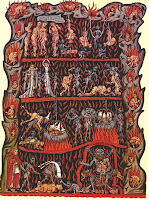
In the Book of Relevation, Judgement Day somehow mutated into a cosmic battle between Satan and his minions versus the Angels. Everyone will wait in hades for Judgement.
Centuries later, Hippolytus of Rome created the impression that in hades, the righteous are happily anticipating judgement day, whist the damned are tormented by the sight of the "lake of unquenchable fire" into which they are destined to be cast into. Somehow, God decide through Hippolytus that the furnance wasn't big enough, so a massive lake of fire was more economical. Somehow, God became this evil tyrant that made you watch your torture device before tossing you into it. That is really worse than death to me.
Centuries later, Saint Augustine (I still don't know how a lecherous pervert like him became a saint) proposed the concept of Original Sin where "the unbaptized go to hell, including infants, albeit with less suffering than is experienced by those guilty of actual sins". Basically, all non-believers are condemned to hell regardless of their moral character. I'm not quite sure how the concept of less suffering will work out. Will I burn at a higher temperature, so I'm reduced to nothing faster? Or will I burn at a lower temperature, so its not so hot, but I take a longer time to be reduced to nothing?
By the medieval era, Gregory of Nyssa's concept of Purgatory was finalized and further elaborated on as a "state of painful purification of the saved after life".
Adapted from personal knowledge and from http://en.wikipedia.org/wiki/Afterlife#Christianity
Naraka of Buddhism
Buddhism has also evolved a lot over time. If Buddha still had a body to flip around in, he'll probably be tossing all over his grave. He created a philosophy that somehow mutated into people grovelling before statues of him today, begging for material wealth and blessings, the very things that he preached against.
I'm very certain that the Naraka was not a concept handed down by Guatama Buddha himself, but a belief created by his disciples. It was probably to make Buddhism more appealing to Chinese and Hindu converts.
Hindu Hell (Naraka)
I like this concept the most because it is realistic in its realization that all beings have at least ONE sin on their record. We are all flawed human beings aren't we...
I'll talk about Islamic and Taoist hell another time if I can't get guest posters.
We have all been taught at one point of time or another that evil souls will be condemn in hell forever. So what exactly is hell? No one knows for sure, when I say this, I meant, no one has reported back in a verfiable manner what hell is like. How many versions of hell are there? Many! I'll explore some here.
Greek Hell

The deceased entered the underworld by crossing the Acheron, ferried across by Charon, who charged an obolus (a small coin) for passage placed in the mouth of the deceased by pious relatives. Paupers and the friendless gathered for a hundred years on the near shore according to Book VI of Vergil's Aeneid. Greeks offered propitiatory libations to prevent the deceased from returning to the upper world to "haunt" those who had not given them a proper burial. The far side of the river was guarded by Cerberus, the three-headed dog defeated by Heracles (Roman Hercules). Passing beyond Cerberus, the shades of the departed entered the land of the dead to be judged.
The five rivers of the Realm of Hades, and their symbolic meanings, are Acheron (the river of sorrow, or woe), Cocytus (lamentation), Phlegethon (fire), Lethe (oblivion), and Styx (hate). Styx forms the boundary between the upper and lower worlds.
The first region of Hades comprises the Fields of Asphodel, described in Odyssey xi, where the shades of heroes wander despondently among lesser spirits, who twitter around them like bats. Only libations of blood offered to them in the world of the living can reawaken in them for a time the sensations of humanity.
Beyond lay an area which could be taken for a euphonym of Pluto, whose own name was dread. There were two pools, that of Lethe, where the common souls flocked to erase all memory, and the pool of Mnemosyne ("memory"), where the initiates of the Mysteries drank instead. In the forecourt of the palace of Hades and Persephone sit the three judges of the Underworld: Minos, Rhadamanthus, and Aeacus. There at the trivium sacred to Hecate, where three roads meets, souls are judged, returned to the Fields of Asphodel if they are neither virtuous nor evil, sent by the road to Tartarus if they are impious or evil, or sent to Elysium (Islands of the Blessed) with the "blameless" heroes.
Taken from: http://en.wikipedia.org/wiki/Hades
In this case, all of the dead have to pass through hell for judgement before they are reassigned to "a place of their deserving".
Ancient Egyptian Hell

When the body died, parts of its soul known as ka (body double) and the ba (personality) would go to the Kingdom of the Dead. While the soul dwelt in the Fields of Aaru, Osiris demanded work as payback for the protection he provided. Statues were placed in the tombs to serve as substitutes for the deceased.
Arriving at one's reward in afterlife was a demanding ordeal, requiring a sin-free heart and the ability to recite the spells, passwords, and formulae of the Book of the Dead. In the Hall of Two Truths, the deceased's heart was weighed against the Shu feather of truth and justice taken from the headdress of the goddess Ma'at. If the heart was lighter than the feather, they could pass on, but if it were heavier they would be devoured by the demon Ammit.
Egyptians also believed that being mummified was the only way to have an afterlife. Only if the corpse had been properly embalmed and entombed in a mastaba, could the dead live again in the Fields of Yalu and accompany the Sun on its daily ride. Due to the dangers the afterlife posed, the Book of the Dead was placed in the tomb with the body as well as food, jewelry, and 'curses'.
Taken from: http://en.wikipedia.org/wiki/Afterlife#Ancient_Egypt
The crimes of those who are condemned to hell consist of nothing more and nothing less than having acted against the divine world order established at the beginning of creation. Hence, they have excluded themselves from ma'at, while at the same time revealing themselves as agents of chaos. After death, they became forever reduced to a state of nonbeing., which was the chaotic state of the cosmos before creation. For them, there is no renewal and no regeneration of life, but only a second, definitive death...
In every respect, the fate of the damned is the opposite of that of the blessed... when the damned died, their flesh was torn away by demons and their mummy wrappings were removed so that their bodies were left to decompose. In the underworld that the blessed successfully navigate, their order of things is reversed, even to the extent that the damned have to walk upside down, eat their own excrement and drink their own urine. Their hands are tied behind their backs, often around stakes. Their heads and limbs are severed from their bodies and their flesh is cut off their bones. Their hearts are removed and their ba-souls are separated from their bodies, forever unable to return to them. They even loose their shadows, which were considered an important part of the ancient Egyptian being. They have no air and suffer from hunger and thirst, as they receive no funerary offerings. Worst of all, they are denied the reviving light of the sun god, who ignores them, even as they cry out load and wail when he passes them in the underworld at night.
Taken from: http://www.touregypt.net/featurestories/hell.htm
The Egyptian belief in the afterlife is very unique in a sense. Like the Greeks, they believed in the Journey through the underworld towards Judgement. However, they demanded the preservation of the body as a means of entering the afterlife. Somehow, over time, money could help you cheat death in these rites- more money means better mummification, so your chances of surviving an eternity is higher; more money means more amulets to ensure that everything is in your favor; more money means more funeral texts to extol your non-existant virtues to the Gods. I think the Gods are more discerning than that, but humans always like to cheat themselves.
Christian Hell
Unfortunately, the christian concept of Hell is a mess. I humbly beg forgiveness for my sarcasm, I can't help it- the christian beliefs have evolved a LOT over the centuries till the point that it no longer follows God's word. According to Christ, Judgement Day will come later (lord know when) where the Angels will seperate the damned from the righteous and throw them into a furnance of fire. Until that day, the dead will remain, well, dead. There is no mention or description about where or what the "waiting" room is. And I wonder if I will die a second death there, or will I just be charred to a piece of crisp bacon, be healed and thrown back in to repeat the cycle for all eternity. That wasn't mentioned specifically as well.

In the Book of Relevation, Judgement Day somehow mutated into a cosmic battle between Satan and his minions versus the Angels. Everyone will wait in hades for Judgement.
Centuries later, Hippolytus of Rome created the impression that in hades, the righteous are happily anticipating judgement day, whist the damned are tormented by the sight of the "lake of unquenchable fire" into which they are destined to be cast into. Somehow, God decide through Hippolytus that the furnance wasn't big enough, so a massive lake of fire was more economical. Somehow, God became this evil tyrant that made you watch your torture device before tossing you into it. That is really worse than death to me.
Centuries later, Saint Augustine (I still don't know how a lecherous pervert like him became a saint) proposed the concept of Original Sin where "the unbaptized go to hell, including infants, albeit with less suffering than is experienced by those guilty of actual sins". Basically, all non-believers are condemned to hell regardless of their moral character. I'm not quite sure how the concept of less suffering will work out. Will I burn at a higher temperature, so I'm reduced to nothing faster? Or will I burn at a lower temperature, so its not so hot, but I take a longer time to be reduced to nothing?
By the medieval era, Gregory of Nyssa's concept of Purgatory was finalized and further elaborated on as a "state of painful purification of the saved after life".
Adapted from personal knowledge and from http://en.wikipedia.org/wiki/Afterlife#Christianity
Naraka of Buddhism
Buddhism teaches that there are five (sometimes six) realms of rebirth, which can then be further subdivided into degrees of agony or pleasure. Of these realms, the hell realms, or Naraka, is the lowest realm of rebirth. Of the hell realms, the worst is Avīci or "endless suffering". The Buddha's disciple, Devadatta, who tried to kill the Buddha on three occasions, as well as create a schism in the monastic order, is said to have been reborn in the Avici Hell.Taken from:http://en.wikipedia.org/wiki/Naraka_(Buddhism)
However, like all realms of rebirth, rebirth in the Hell realms is not permanent, though suffering can persist for eons before being reborn again. In the Lotus Sutra, the Buddha teaches that eventually even Devadatta will become a Buddha himself, emphasizing the temporary nature of the Hell realms. Thus, Buddhism teaches to escape the endless migration of rebirths (both positive and negative) through the attainment of Nirvana.
The Bodhisattva Ksitigarbha, according to the Ksitigarbha Sutra, made a great vow as a young girl to not reach Enlightenment until all beings were liberated from the Hell Realms or other unwholesome rebirths. In popular literature, Ksitigarbha travels to the Hell realms to teach and relieve beings of their suffering.

Buddhism has also evolved a lot over time. If Buddha still had a body to flip around in, he'll probably be tossing all over his grave. He created a philosophy that somehow mutated into people grovelling before statues of him today, begging for material wealth and blessings, the very things that he preached against.
According to tradition, the Buddha emphasized ethics and correct understanding. He questioned the average person's notions of divinity and salvation. He stated that there is no intermediary between mankind and the divine; distant gods are subjected to karma themselves in decaying heavens; and the Buddha is solely a guide and teacher for the sentient beings who must tread the path of Nirvāṇa (Pāli: Nibbāna) themselves to attain the spiritual awakening called bodhi and see truth and reality as it is. The Buddhist system of insight and meditation practice is not believed to have been revealed divinely, but by the understanding of the true nature of the mind, which must be discovered by personally treading a spiritual path guided by the Buddha's teachings.Taken from: http://en.wikipedia.org/wiki/Gautama_Buddha
I'm very certain that the Naraka was not a concept handed down by Guatama Buddha himself, but a belief created by his disciples. It was probably to make Buddhism more appealing to Chinese and Hindu converts.
Hindu Hell (Naraka)
Early Vedic religion doesn't have a concept of Hell. Ṛg-veda mentions three realms, bhūr (the earth), svar (the sky) and bhuvas or antarikṣa (the middle area, i.e. air or atmosphere)). In later Hindu literature, especially the law books and Puranas, more realms are mentioned, including a realm similar to Hell, called naraka (in Devanāgarī: नरक). Yama as first born human (together with his twin sister Yamī) in virtue of precedence becomes ruler of men and a judge on their departure. Originally he resides in Heaven, but later, especially medieval traditions, mention his court in naraka.Taken from: http://en.wikipedia.org/wiki/Hell#Hinduism
In the law-books (smṛtis and dharma-sūtras, like the Manu-smṛti) naraka is a place of punishment for sins. It is a lower spiritual plane (called naraka-loka) where the spirit is judged, or partial fruits of karma affected in a next life. In Mahabharata there is a mention of the Pandavas going to Heaven and the Kauravas going to Hell. However for the small number of sins which they did commit in their lives, the Pandavas had to undergo hell for a short time. Hells are also described in various Puranas and other scriptures. Garuda Purana gives a detailed account of Hell, its features and enlists amount of punishment for most of the crimes like a modern day penal code.
It is believed that people who commit sins go to Hell and have to go through punishments in accordance with the sins they committed. The god Yamarāja, who is also the god of death, presides over Hell. Detailed accounts of all the sins committed by an individual are kept by Chitragupta, who is the record keeper in Yama's court. Chitragupta reads out the sins committed and Yama orders appropriate punishments to be given to individuals. These punishments include dipping in boiling oil, burning in fire, torture using various weapons, etc. in various Hells. Individuals who finish their quota of the punishments are reborn in accordance with their balance of karma. All created beings are imperfect and thus have at least one sin to their record; but if one has generally led a pious life, one ascends to svarga, a temporary realm of enjoinment similar to Paradise, after a brief period of expiation in Hell and before the next reincarnation according to the law of karma.

I like this concept the most because it is realistic in its realization that all beings have at least ONE sin on their record. We are all flawed human beings aren't we...
I'll talk about Islamic and Taoist hell another time if I can't get guest posters.
Subscribe to:
Posts (Atom)


