Chat Box- For discussions/debates only

Announcements

22 December 2009 @ 18:30 hours

Dear readers,

Sorry for the retarded rate of blogging. WK and DM are and will be riduculously busy until further notice. We will try to post once in a while, so stay tuned.

DM will try to monitor/manage the chatroll whenever possible. Meanwhile, Ivan and Evone have been given administrative rights to ban unsavory individuals from the chatroll.

Chatbox rules have been shortened.

Friday, December 25, 2009

Strange Creatures Series- Do Ghosts exist? Part 2

Hey everyone,

I think I love ghosts too much. Hehehe, so I'm going to post up some more ghost pictures that I personally believe to be authentic but wasn't on the weblink that I posted up yesterday. Here we go:

When I first saw this picture, I thought the kid was the one crying in the foreground. However, someone helpfully added the red circle and now you can see a little girl posing with the adults. =)
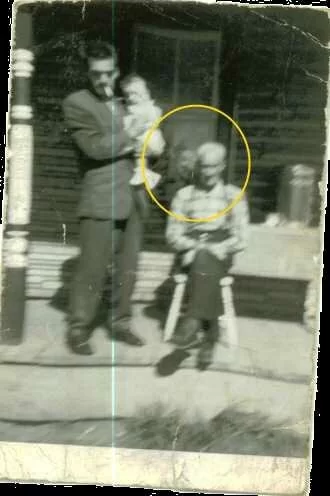


Apparently the ghostly face behind the old man belongs to his wife. Nice to know that your loved ones are still sticking around and waiting for you to kick the bucket.


Look at the state of the building. It is so heavily blocked up I doubt if anyone can go up there and yet there is a very clearly image of someone in period dress. Looks like 17th century to me. It looks fake to many people I know, but to me, I think it's real because it seems to be "glowing". The surrounding areas around it are dark and if there's a light trained on it, the surrounding areas would be lighted up as well, but that didn't happen. The light seems to be coming from the figure itself. So yeah, go figure.

In addition to these manifestations, I would also like to talk a little about object possession. It seems ghosts have the ability to possess objects and manifest hauntings through it. For the Chinese readers out there, I'm sure you'll remember your parents telling you not to pick up stuff randomly from the roadside. And I'm sure if you read Russell Lee, you'll probably recall stories of "bad luck coins" or people bringing home haunted vases, toys, etc... However our Asian hauntings are not as widely documented as the Western ones. So I have to settle for showing you guys hauntings from the West.

Robert the Doll
Robert, sometimes known as Robert the Doll, is a doll that was once owned by Key West painter Robert Eugene Otto. The doll is approximately 100 years old. The creepy thing about this doll is the owner's treatment of it. He treated it as an independent invididual and it is alleged that the doll can move on it's own. He was seen darting up and down the stairs and people could here his feet tapping on the floorboards.


If you guys aren't too young, you'll probably recall the alleged hauntings of Teletubbies and Furbies Well, I'm not quite sure about the details but I heard of rumours of the voice actors committing mass-suicides. Anyway, if you notice, no more teletubbies are on sale, no more new episodes have been filmed ever since that happened. I know of kids who still enjoy watching them, so I won't say it's due to a fall in demand... Mysterious...

You can read more about haunted dolls here. There's Mandy and Annabelle for you to read up on.

Moving on from the haunted dolls, other haunted objects are typically refered to as cursed. Let me identify some famous "cursed" objects for you.

Diamonds
Diamonds are a girl's best friend, or her curse? There are 2 infamous diamonds that are allegedly cursed and plague their owners with a string of misfortune and death. They are the Hope Diamond and the Lorenzenstien Diamond.


Busby's Stoop Chair
Thomas Busby a local man became partners with his father in law Awety in the illicit coining business at the hall. It was reported, Busby a bully and drunkard, returned home to discover Daniel Awety sat in his favourite chair and after an argument threw Awety out. It is said, Awety threatened to take his daughter Elizabeth away from Busby and return her to Danotty Hall.


Later that night Thomas Busby went up to Danotty Hall and bludgeoned Daniel Awety to death with a hammer. After murdering Awety, Busby hid the body in nearby woodland. When Awety failed to appear, a search was mounted which led to the discovery of Daniel Awety's body and the arrest of Thomas Busby.

Busby was tried at York Assizes in 1702 and condemned to hang and his body dipped in pitch and left in a gibbet opposite the coaching inn at the cross roads on the old great north road leading into Thirsk.

As Thomas Busby was being lead to his execution he is supposed to have cursed anyone who dared sit in his chair. Thereafter the inn became known as the Busby Stoop Inn and the curse of the chair was born, or was it?

It's now suggested, the Busby Stoop chair famously hanging in the Thirsk museum (so no one can sit on it) and the focus of so much fear, might not have been made until after 1840, some 138 years after Thomas Busby's execution.

It is alleged that there has been a string of fatal incidents linked to individuals who have sat in this chair during the 1970s. So beware...

Taken from here.

Thursday, December 24, 2009

Strange Creatures Series- Do Ghosts exist?

Do ghosts exist?

Do you believe in ghosts?

What is a ghost?

A ghost - or spirit or apparition - is the energy, soul or personality of a person who has died and has somehow gotten stuck between this plane of existence and the next. Most researchers believe that these spirits do not know they are dead. Very often they have died under traumatic, unusual or highly emotional circumstances. Ghosts can be perceived by the living in a number of ways: through sight (apparitions), sound (voices), smell (frangrances and odors), touch - and sometimes they can just be sensed. Taken from here.

Now, it is possible to prove the evidence of ghosts by capturing pictures/videos of them with cameras, capturing their voices on recorders (EVPs), tracking them down with EMF meters (electromagnatic field)or thermal cameras, etc. Some of these may be real, some may be fake. So intepretation has to come about through experience. =)

Many people they declare that they don't believe in ghosts. But I have a question, if ghosts don't exist than why is it that every culture has it's own version of ghosts? Today, when we think of ghosts, what comes into mind is a pale figure or a severely decomposing figure that suddenly appears out of no where and tries to scare you to death or kill you. This is the stereotype image of ghosts thanks to cinemas.

Based on years of reading and researching, I would say that ghosts are probably harmless and most of the time, they aren't what the movies potray them to be. Most of the time, humans are the ones that scare themselves. Ghosts are usually harmless except for poltergeists who are capable of throwing things at people and in extreme cases, scratching them pretty badly. There are some ghost pictures taken and I don't think they are fake. I've attached 2 links here so that you can read up more by yourself:
- Real Photos (or rather, no evidence of forgery)
- Alleged Ghost Pictures (Evidence of manipulation be it intentional or unintentional)

I have some video clips for you guys to see. I follow only 2 ghost-hunting shows- Most Haunted and Ghost Hunters. There is a difference between the two.

Most Haunted has a "psychic" medium in the crew and they go into an allegedly haunted location thinking that it is haunted and start to scare themselves silly. I won't make any comments about whether they faked evidence whatsoever. I would just like to highlight how their psychological state is affected by their expectations of an angry vengeful ghost. They conduct seances, complain of cold spots or having rocks thrown on them. Unfortunately the lack of control in terms of who was where at which point and the lack professional equipment like thermometers or EMF detectors left room for doubt. However, they have a parapsychologist in the team who objectively questions evidence and rarely concedes that an evidence might be paranormal unless he cannot attributed it to something else.

Ghost Hunters go in with the expectation that the place is not haunted unless they are convinced by the evidence. They don't have a psychic with them but they used electronic devices like an EMF meter or a torchlight to communicate with the "entity". They leave the device away from them and ask for responses to their questions. If there's nothing they can find in terms of video evidence, audio recordings or personal experience, they will just tell the host that the place is not haunted in their opinion. You don't see a group of people screaming and running away at the slightest noise. Ghost hunters will trace down the source of noise and try to explain it. If they can't, they'll conclude that it's probably unnatural. E.g. If there's a thumping sound on the roof, they'll send one member up to the roof and run/jump all over it. They'll try to see if they can replicate the noise. =)

So here we go:

Most Haunted:

Listen out for the gutteral "hello" at 2min++. I'll be much happier if Stuart didn't get scared to bits and investigate further by seeing if he can replicate it.

I'm going to post up the entire series on Derby Gaol. It's an old jail and Yvette seems to be experiencing a whole range of emotional outbursts (to be honest, it might be real because in places like the Edinburgh Vaults, people inexplicably breakdown into tears at certain areas). And Derek the medium seems to be pretty dramatic. If you hear Derek talking to someone invisible called "Sam", it's his spirit guide.


Ghost Hunters:


This is one of the best EVP (electronic voice phenomenon) that I've ever heard. =)


P.S. The camera guy is a guy. And there's no other female around them.

Happy watching and form your own conclusions about whether ghosts exist. To end it off, I'll include another 2 videos of my favorite comedians- French and Saunders, who created a parody of Most Haunted.


Tuesday, December 22, 2009

Happy X'mas!!

Hello guys!!

I'm so sorry I've been to busy and lazy recently to post anything up. I think my brain is too tired. Because X'mas is coming up, I've decided to post up some videos to share with you guys. =) It has nothing to do with the contemplasian goals or ideals but heck, its X'mas, time to have fun yar? It's a rather macarbre collection of videos about nature from youtube that I've specially selected for you guys. Have a great X'mas, have lots of nice, clean fun.

P.S. By the time you're done watching this, you'll probably never look at turkey stuffing, cottage cheese, cream or any bump on your skin quite the same way again. *Evil Laughter*

Booomz- Staph's infection


Bot Flies


Just in case you guys have no idea what botflies are:


Funny Urophilic Orang Utan

Cheerios,
DM

Monday, October 5, 2009

Extra-ordinary people: Are they better off dead than alive?

Sorry for the lack of updates, I've been obscenely busy. Anyway, today, I'm sharing some videos from youtube. The theme is basically concerning living miracles- are they better off dead than alive?. After talking to so many people who are so caught up in the miseries of their personal lives, I've decided to do a post about some individuals who are suffering more than us and hopefully, we would learn how to appreciate ourselves and those around us better. The following videos are GRAPHIC. I hope that after watching them, no one will say anythig insensitive.

The Boy with Half a Brain

Poor kid got shot in the head. It is pretty much a miracle how he survived without half of his brains. I could tell that most of his right parietal lobe is gone. That is the part of the brain that deals with sensory-motor functions. People with brain damage there have problems trying to match the real world with the perceived one. So if you had them a card and tell them to slot it into the box, they can probably describe the slot to you but can't put it into the slot. This is but one example and it doesn't occur all the time. Because the brain is such an intricate organ, damage to one tiny part alone can cause a LOT of problems.

Treacher Collins Syndrome

This is a genetic illness caused by recessive genes. When I saw this video, I was more disturbed by comments that the kid is better off dead than alive. I just wonder if that is the right attitude to have but honestly, I rather my parents finish me off if I look like that... (Yes, I'm horribly vain.)

A Woman without Arms

I really have to take off my hat to this lady. She is probably a living proof that physical deformity is not the end of the road towards a fulfilling life. =) Her determination is truly a source of inspiration. I just feel sad that there are people who rather criticize her for being imperfect rather than admire her for her courage and determination.

8 limbed girl

I always believed that whilst people should respect traditions, they should no be a slave to them. This girl is obviously no having a good life and instead of seeking help, she is denied treatment because they believe her to be a reincarnation of Lakshmi.

The Tree Man


The Man with a 20kg tumour on his face


Looking at all the people above, is it right to say that they are better off dead than alive? Are their lives worthless and meaningless just because they were not born physically perfect/wholesome? I think there are too many issues to contemplate over this.
1. Should parents have the right to let their children die naturally if they are born imperfect?
2. Does the society have the right to eliminate the imperfect people of the world (assuming social darwinist mentality is applicable here)?
3. Are the "victims" allowed a choice to live or die?
4. Where do we draw a line between "not worth living", "worth a try" and "still can cope"?

Monday, September 21, 2009

Intelligence

From The Blue Sweater, posted 21 September 2009

Note to readers of ContemplAsian: Sorry, I have not been posting for some time. Here's one from The Blue Sweater that would be quite meaningful...

I was having a long conversation with De Maitre about this topic, a topic that in many ways affect all of us in one way or another.

We talked about three things, the meaning of intelligence, government by elites, and of course, this:


The meaning and purpose of exams.

What is intelligence?

It’s a question that I have addressed many times while writing posts for ContemplAsian, Maitre’s blog. But more often, I expounded on the problem of the meaning of intelligence being misinterpreted or distorted, rather than exploring the true meaning of intelligence.

We all know in our society, intelligence is measured by grades and certification. But what Maitre has persistently tried to tell me in our conversation was that there must be more to intelligence.

I certainly agree.

But the thing is, the idea of intelligence, like many things of a conceptual nature, runs into philosophical problems.

I was reminded of my Philosophy module at this point. For the module, I covered one of Plato’s dialogues, entitled Meno, part of which is a discussion between the characters Meno and Socrates on the nature of “success”.

And one thing that is in common with both the ideas of “intelligence” and “success” is that it is extremely difficult to identity the one single criterion or factor that could define the idea.

Take Meno, for example. We can be successful as doctors, as scientists, as historians, as teachers, but what is common between them? Ultimately, it doesn’t answer the question, what IS success?

Likewise, we can be intelligent in this subject, intelligent in another, but what IS intelligence? Still not quite answered.

Of course, one might just give up and say that to come up with the questions I have put up above is itself intelligence.


Next, government by elites.

It’s one of Singapore’s key ideologies - Meritocracy. Those with the ability and skills should and could manage the affairs of the state.

But this reveals a fundamental question:

Do we need elites to govern, if governance is about furthering the interests of the people?

Because here we assume the elites know our interests. But can we always be so sure?

On the other hand, if we don't have elites (or experts, to use a less loaded word), then will things turn out right for the state?

Maitre brought up the idea of separating “technical” skills from the raw ability to lead, but I can’t help but feel that this dichotomy is fundamentally ambiguous. For a start, what is meant by “technical” skills? And what is meant by the “raw ability”?

Even if we take skills to be things like knowledge in economics, public administration, etc, it doesn’t separate leadership from the elites. And even if we say leaders should have the “raw ability”, it doesn’t necessarily mean they are the ones leading.

For example, the result is the bureaucratic state, where real power lies in the bureaucrats rather than the politicians.

This reminds me of a quote: Leadership is Action, Not Position.


Last, examinations.

Maitre was critical of the exam system. Well, such criticism is to an extent justified. The exam system sometimes creates undesirable effects that affect the overall well-being of the education system.

I once wrote a post in ContemplAsian about exams. There, I explored why we needed exams in the first place. Exams are needed as a mechanism with which to incentivise hard work and penalise sloth. This is the most important reason for exams.

Of course, many states and societies also come to use exams as a measure of success and as a tool of academic advancement, but these are, to me, secondary reasons, because many societies (especially in Europe) don’t have stringent exams, but still achieve (arguably) these results.

In a line, exams are a mechanism for competition.

It is true that exams can distort the meaning of education. When people forget the purpose of education and think that they “study so as to pass exams”, then education truly loses meaning.

But I think it’s not so much the institution of exams, but the procedures within the institution.

Take for example Continual Assessment. In university, part of it is participation in tutorial. The trouble with making such things gradable is that it creates certain... how should I put it... strange effects.

This is because participation is subjective, if not downright ambiguous. What is wanted is “meaningful participation”, but what exactly is “meaningful participation”?

So we have people talking a lot, but you can sense they are just hoarding air time.

And for people with nothing or no time to say anything, is it fair to them that they be penalised?


So what is intelligence? Turns out I still haven’t answered the question...

Friday, September 18, 2009

The Battle of the Sexes- who is worse when it comes to keeping secrets?

A new study has suggested that women cannot keep secrets for more than 47 hours.

Researchers found that women are overcome by a burning desire to share gossip as soon as they hear it.


They will typically spill the beans to at least one other person in 47 hours and 15 minutes.

The study of 3,000 women aged between 18 and 65 also found that four out of ten admitted they were unable to keep a secret – no matter how personal or confidential the news was.

Intimate issues, true cost of purchases and affairs emerged top of the secret-keeping list, with girls most likely to share a secret chatting face-to-face, on the phone or via a text message.

Fortunately for some though, over a quarter (27 per cent) said they forgot what they were told the following day

Taken from: http://www.telegraph.co.uk/news/newstopics/howaboutthat/6199822/Women-cannot-keep-a-secret-for-longer-than-47-hours.html


That's not all, men have been found to gossip more than women because they need an ego boost.
MEN indulge in gossip more than women about secret liaisons, inept lovers and overpaid colleagues, a study says today.


It helps boost their confidence, says the survey of American college students. Women are more inclined to pass on tittle-tattle to bond with their friends and build closer relationships with colleagues.

Presenting her findings at the American Psychological Society's annual conference in Toronto, she said the report challenged the widely-held view that women gossiped more than men. She said: "Men definitely seem to be getting more out of gossiping than women.


"We found that men felt better about themselves when they criticised another person's behaviour. It gave them a sense of moral superiority and showed others that they knew the difference between right and wrong."

Miss Hom added that rather than creating strife in the office, gossip tended to relieve the stress of arduous work and the long hours spent in front of a computer screen. She said: "It is a vital function of social inter-action. Often it helps to break the ice among people."

The findings follow a study by the Industrial Society that said gossip should be encouraged in the office by providing more communal areas in the workplace.

Prof Nigel Nicholson, a psychologist at the London Business School and the author of a book on human behaviour, Managing the Human Animal, said: "Men enjoy a gossip as much as women, but they call it networking instead."
Taken from: http://www.telegraph.co.uk/news/worldnews/1311999/Men-gossip-more-than-women-to-boost-their-egos.html

Well well, it seems both genders can't keep secrets at all! The only difference lies in their motivation for revealing secrets- men for the sake of "networking" and "ego", and women for the sake of "stress relief". Personally, I never trusted both sexes much. After all, you'll never know when you'll argue with friends and stop talking to each other. And you can never predict if your former friend wouldn't spill the beans on you.

Are Singaporean parents Authoritative or Negligent when bringing up their children?

This post will be an extension of my previous post- "Should the parents of Ah Lians/ Ah Bengs be blamed for their deviant behavior". This time I will focus more on the parenting techniques identified by psychologists and what kind of children do they create.

Have you guys realized that over the past 10 years, there has been a sudden boom in the market for family/parent related magazines, forums and websites? In my opinion, this sudden surge in parenting interest could be due to the following factors:

-More highly educated parents who believe in the virtue of using “science” to establish the “best” parenting style for their children.
-Guilt that parents aren’t spending enough time with their children
-Increased social pressure to be nothing but the best. So parents want the best kids and hope to achieve that through the best parenting approach.
So what parenting styles are there? A psychologist named Barumrind came up with the concept of a tripartite classification of parenting styles in 1967 using four orthogonal dimensions- consistent discipline, maturity demands, destructiveness and encouragement of independent conducts. This results in 4 types of parenting styles: Authoritative, Authoritarian, Permissive and Neglecting.


This model is way too US centric anyway. =) In local Asian culture, beating children who are naughty is NOT considered abusive as long as it doesn't cross the line of causing the child long term emotional, psychological and physical trauma/injury.  In the US system, they don't hold to the "spare the rod and spoil the child" ideology, so Asian parenting styles are classified as Authoritarian parenting simply because they lack the element of warmth. The Asian and European perception of warmth differs greatly. To Europeans, warmth/love is expressed through physical expressions of affection, such as hugs and kisses. To Asians however, warmth/love is expressed through less "intense" means such as cooking herbal chicken soup, nagging, caning a child when he/she is naughty, etc.

It is commonly excepted that the Authoritative parenting style is the most effective, especialy if parents adopt a democratic approach to parenting (as suggested by Baldwin et. al. in their 1955 paper). The democratic approach refers to parents who communicate the demands of the real world to thier children instead of their personal demands.

Given the penchant of Asian parents issuing orders to their children on what to do and what not to do, punishing disobedience with physical (canning), emotional (locking children out of the house) or verbal (shouting) aggression, Europeans think that Asians only practice the Authoritarian style of parenting, which generally creates more obedient and submissive children who appear to be less spontaneous, curious and creative. However, I would like to question- are Asian children obedient and submissive because of their parents or because of cultural norms?

Ask any Asian parent and they will tell you that they cane their children because they love them not and it is for their own good. Asian parents would also say that they make decisions for their children because their children are not ready to make an informed choice. These examples clearly violate the typical American belief that punishing children would result in nothing parental abuse in the long run and that children should be given the independence to make their own decisions in life.

In other words, Asian parenting should resemble the Authoritative model, so it should be within healthy boundaries. Unfortunately, the model does not account for additional factors such as parental kiasu-ism and having the fostering of parenting duties to maids.

To me, I think Singaporean children are over stressed by their parents' expectations of them. Furthermore, given our traditional beliefs, many Singaporean children today can't differentiate between what they want and what their parents want out of them. Somewhere, somehow the line got blurred along time. I think it’s just plain sad that many of the teenagers I’ve met don’t know what they are doing in life. They are just caught in the web of confusion stemming from a loss in life goals.

With the increased affluence among Singaporeans stemming from having both parents working full time, I would suggest that many Singaporean children suffer from emotional neglect even though their daily needs are met by their maids. For one, their parents return home late at night tired and irritated from a hard day at work. They usually spend a little time with their children but do not want to be bothered by their children’s constant demands for attention. I’ve seen parents telling their kids to go watch TV whenever their kids try to start a conversation on mundane stuff like “Daddy, Mummy, today my friend had a birthday party in school! We had a lot of balloons, than her parents brought ... … …” (you know children and their endless capacity for chatter).

I think Asian parents need to move on with time, given the exposure to western ideals that their children gain from watching television, young children today expect their parents to express more caring questions that most American parents typically portray in movies. These questions could be as simple as “how was your day in school?” or “did you enjoy yourself with your friends?”. This expectation failed quite badly in the face in typical Asian brusque mentality where the most likely question that children receive when they reach home after school would be “do you have any homework?”, “do you have any tests coming up?” or “any results out?”. That’s quite disheartening.

I also think parenting standards have dropped a lot in Singapore. I’ve met parents, who are blissfully ignorant of their child’s favorite dish, what time the child has to go to school, and the worst sin of all, they forgot their child’s birthday. And the saddest part of all, it is often the maid who remembers all of these. Parents leave their maids to make sure that their children have been fed, showered and have done their homework. Which inevitably, leads us to this conundrum of mine once more: "Are Singaporean Parents Authoritative in their approach but Negligent to their child's emotional needs?"